Biceps
& Triceps Workout - "Athletic Guns" (originally
published at now defunct ruggedmag.com)
When I started out training in high school, I got most of my
training information from the same place everybody else my age
did (and may still do) - bodybuilding magazines. I read all
the magazines I could get my hands on, soaking up the information
like a sponge. I went on a bodybuilding-inspired, very volume
heavy routine. Add up the facts that I was relatively new to
training , I was getting plenty of sleep, I ate a lot of good
food, and I had the raging hormones of a teenager, and the result
was that I made pretty good gains.
The longer I trained, the more I learned. While still in high
school, I shifted much of the focus of my training from hypertrophy
to strength gains (albeit still a volume heavy routine). Because
of the factors I listed above, I still made great gains. After
beginning college, I began to realize that I wasn't going to
have the time, energy, or recuperative powers to train that
I had in high school. I was now much busier, and had a lot more
"on my plate" (so-to-speak). This led me to continue reading
and continue researching training. I still wanted the same sorts
of results, but didn't have near the time. There had to be a
way to get more "bang" for my training "buck," and I was determined
to find it.
It was also around this time I began to take an interest in
Mixed Martial Arts (MMA). I didn't have the time or resources
to train in MMA at the time, but I altered my weight training
to meet the needs of an MMAist. As usual, I continued to research,
study, and experiment with various training methods - all the
while looking for the biggest "bang" for the "buck."
Over these years, as my reading, study, and research gradually
shifted from straight bodybuilding to Strength & Conditioning
(S&C) training for athletes (especially MMA), I began to
become aware of the distinct dichotomy of bodybuilding and S&C
training.
Because many, if not most, strength trainees/athletes have
other physical activities to perform (sports practice, conditioning,
skills sessions, GPP, agility work, etc.), you'll not see them
perform any exercise or movement that doesn't somehow correlate
to increased performance on the field, court, or mat. They have
so much physical work to do, and since nobody has an unlimited
work capacity, they only have so much recuperative ability to
apply to their training. As such, any extraneous "fluff" work
is eliminated.
This is why you rarely see strength trainees using isolation
movements. (It's more complicated that this, but) the basic
reasoning or gist is "Why target one muscle group with a movement
when you can target two, three, or more?" Again, it's all about
bang for the training buck. Because of all this, you hardly
ever see a strength trainee who does any direct arm work. Most
biceps and triceps exercises are isolation movements, which
many strength trainees don't have the time or recuperative abilities
for. Besides, the biceps are hit during most pulling exercises
(chins, rows, high pulls, cleans, deadlifts, etc.) and the triceps
are hit during most pressing exercises (flat bench, incline
bench, overhead presses, dips, etc.). This is good enough for
most athletes.
However, from time to time, you see a strength trainee who'd
like to put some size on his arms. Almost immediately, his strength
trainee/athlete buddies scoff him at, because arm training is
considered unnecessary "foo-foo" work for bodybuilders. (Incidentally,
you'll find that most strength athletes hold the idea of bodybuilding
in high contempt - but that's another story.) Usually, the trainee
is either convinced to just not worry about it ("Just do 'functional'
training instead!") or to just do some more compound movements
(presses and/or pulls).
Now, there is nothing wrong with wanting to look good. So I
think the idea of talking somebody out of it stinks. While I
think that strength, conditioning, and being athletic should
be every trainee's priorities, there's not a darn thing
wrong with wanting to put some meat on the ole' guns so that
they stretch your T-shirt a little. I know you want to succeed
on the field, but having a pair of arms that catches that little
cutie's eyes the next time you're at the dept. store has its
advantages, too!!
As far as directing more focus toward compound movements goes,
well, that does and doesn't work. Yeah, you'll put more size
on your arms, but you'll put more size on everywhere else, too.
Now, your arms will be bigger, but since so will everything
else, the proportion you're looking for (i.e. how big
your arms look, not are, but look, in relation to the
rest of your upper body) won't be there.
So, what to do? You want to gain some arm size (in proportion),
yet still need/want to stick with compound movements, and continue
your other training. I've got a great biceps and triceps
workout program for you.
Monday - Workout #1
Tuesday - Off
Wednesday - Workout #2
Thursday - Off
Friday - Workout #1
Workout #1
-Steep 14" Incline Bench Press
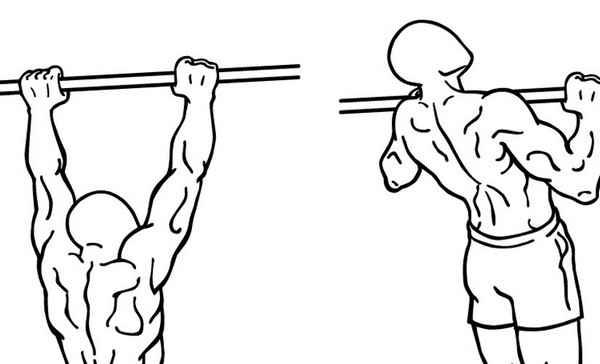
-(Weighted) Curl-Grip Chins
*alternate x 20 minutes
-DB or Hammer Curls: 2-4 sets x 8-15 reps
-Pushdowns or Lying Triceps Cross Faces: 2-4 sets x 8-15
reps
The main portion of your workout will be the 20 minute block.
During this 20 minutes, you'll perform a routine that is sort
of a cross between by "Singles
& Doubles" program and Bryce
Lane's "Have It All" program. Choose a certain
rep count that you'd like to achieve in 20 minutes. Personally,
I usually choose something between 40-60 (depending on the exercise).
Using many sets of 1, 2, or 3 reps (sets of 4 is pushing it
in my book), try to complete your given number of reps in each
exercise. Alternate sets of Bench Press and Chins back and forth,
and try to keep rest minimal between sets. So, if you wanted
to get 60 reps with sets of 3, you'd have to do 20 sets of Benches
and 20 sets of Chins within 20 minutes. Sound demanding? Darn
right it is. Now, just because it's demanding doesn't mean you
get to use a light weight. In fact, the purpose of doing more
sets of low reps (as opposed to a few sets of high reps) is
so that you can continue to train heavy. Start with 65-70% of
your 1RM in each exercise and increase from there.
If you've never done training like this before, you're in for
a shock. More than likely you won't be able to get all your
reps in on the first workout. That's Ok - just keep compressing
your rest periods until you can. Once you can get all your reps
in 20 minutes, up the weight and start over. Remember, this
isn't supposed to be easy. It should be tough as hell to get
all your reps in.
So why the Benches and Chins? While they're still compound
movments, they both place a lot of stress on the arms (more
so than other exercises). The Chins are a great biceps exercise
when you concentrate on pulling with your biceps, and the Benches
(your grip is ~14 inches apart, your elbows should remain tucked
in at your sides, and the angle of the bench should be ~70-75
degrees) will just pile the meat on your triceps.
After the 20 minutes is done (if you went heavy enough), your
entire upper body will be pumped up, and you'll feel like you
just got hit by a truck. But you're not done yet. Crank out
2-4 sets of 8-15 reps on some Dumbbell or Hammer Curls and some
Pushdowns or Lying Triceps Cross Faces. This will finish off
any "oomph" you had left in your arms. This will also direct
more of the blood that's already being pumped to your upper
body into your arms. Finish off with some pinch gripping, bar
hang, or other grip movement, and call it a day.
Workout #2
While this is an arm focused program, you don't want to lose
sight of other important attributes such as explosiveness, lower
body strength, flexibility, or total body synergy. So let's
do some of that in Workout #2.
-1 Arm DB Clean & Front Squat x 20 minutes
Remember the 20 minute program you did in Workout #1? Well
cowboy up, because you're going to do it again. Ths time, you'll
be doing it with the 1 Arm DB Clean & Front Squat.
Like in Workout #1, pick an overall rep count between 40-60.
Your objective will be to complete that many reps ON EACH SIDE
within 20 minutes. Also, like in Workout #1, you'll do sets
of 1, 2, or 3 reps (no 4s this time), and it should be absolutely
brutal to get all your reps in by the 20 minutes mark.
When doing your sets, you'll be doing what I call "1 Left,
1 Right." That means you'll do one rep with the left hand, one
rep with the right, one left, one right, etc. until you've completed
your desired number of reps. Let's say again you're doing 60
reps in sets of 3. You'd switch back and forth between your
left and right hands doing one rep in each until you'd done
3 reps on each side before taking a short breather. You'd repeat
that 20 times.
The Clean & Front Squat will work virtually all athletic
factors that are important - lower body strength, explosiveness,
hip drive and flexibility, total body movement, etc. Oh, and
if you're conditioning needs some work, get ready - you've never
seen 20 minutes last so long.
That's it. If it doesn't look like there's a whole lot there,
it's because there isn't. It's just a little over 60 minutes
of strength training per week. After ~3-6 weeks, go ahead and
alter your schedule back to a more athletic focus.
On the "Off" days, stay active. Do some conditioning work (I'd
recommend something that's HIIT based) two or three times per
week. Don't be afraid to do some Active Recovery work or other
physical activities (calisthenics, gymnastics, walking, your
favorite sport, etc.) a few times per week as well. If you're
currently training or practicing a sport, then this is already
taken care of. Just watch out for overtraining - as long as
you eat right and get enough rest, you should be Ok.
Train Hard, Rest Hard, Play Hard.
|
|