"Are
You a 'Strong Man?'” (orginally published at mmaweekly.com)
We’ve all seen strongman competitions on television.
Picking up Atlas Stones, pressing Logs overhead, carrying huge
Oxygen cylinders, pulling semi-trucks – all events that
are commonplace in strongman competitions.
In many ways, professional strongman resembles MMA –
especially MMA’s beginnings. It’s a small, lesser-known
sport with little media coverage. Though its participants are
“professionals” (in that they are paid to compete)
and are the best in the world at what they do, it pays very
little in comparison to other professional athletic endeavors
around the world (though MMAists are now being paid more and
more). Very few (if any) strength athletes earn enough (between
prize money and sponsorships) to train full-time – most
have to work a full-time job and train in their spare time.
There used to be one major organization/competition, and that
was the World’s Strongest Man (the contests you see sponsored
by Met-Rx on ESPN). However, a few years ago, the IFSA was formed
and holds its own contest. While the WSM contest features athletes
from all over the world, this is the contest that American professional
strongmen primarily compete in. IFSA, on the other hand, has
a more international influence.
Another striking similarity between strongman and MMA is development
in its athletes. When MMA (primarily the UFC) first started,
it was a contest between styles – karate vs. boxing vs.
wrestling vs. judo vs. jiu-jitsu vs. muay thai, etc. Strongman,
on the other hand, started back in the mid-1970s with the WSM.
This contest brought athletes from all different arenas to include
Olympic lifters, professional football players, bodybuilders,
martial artists, track and field throwers, and more. Since their
beginnings, athletes from both sports have drifted away from
their specific influence(s) to be well-rounded athletes that,
while they may have their own specializations within their given
sport, can do well at anything.
All that aside, let’s take a look at strongman itself.
The idea of strongman is to try and test strength (as well as
strength-based conditioning) in “odd” ways that
not only don’t tend to show up in regular, everyday life,
but neither are they in the gym.
For example, instead of pressing a barbell, press giant log
that gets in your way, a bar with two giant weights hanging
from it (making momentum a giant issue), or a giant block of
aluminum. Instead of picking up a barbell or set of dumbbells,
pick up a giant round stone with no handles and that is hard
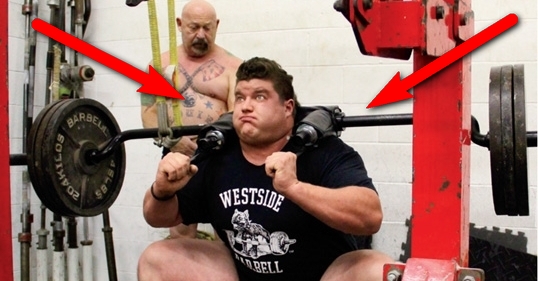
to hold onto. Instead of doing squats with a barbell, do squats
at the end of a giant lever that barrels (additional weight)
are dropped into between reps.
This sort of training is not only good for strongman contests,
though. It’s a perfect fit for MMA. Getting good at holding,
moving, carrying, or manipulating big, heavy objects at odd
angles, in bad positions, and with little to no leverage, grip,
or assistance. Think that sort of thing wouldn’t be good
for MMA? Damn right it would.
Now, doing strongman training isn’t exactly easy to pull
off – especially if you work out in a commercial gym.
Not too many gyms I know of (at least the major gym chains,
anyway) have a set of Atlas Stones, a steel log, or giant oxygen
cylinders for you to carry around.
However, that doesn’t mean you can’t improvise
and do some of this training on your own, anyway.
Sandbags are a PERFECT fit for strongman training and conditioning.
I’ve written about the benefits of sandbags numerous times,
so I won’t repeat myself again. Just know that you can
do a ton of exercises with them, they’re cheap and easy
to make, shift and move to make lifting it harder, and have
been the result of many-a-trainee cussing at the end of my workouts.
Hehehe
Still need examples for the sandbag? Ok. You might not have
a set of Atlas Stones available (though they’re not as
hard to make as you might think), but you can bear hug your
sandbag and carry it around. Replicate the event of loading
barrels with your sandbag. If nothing else, shoulder the sandbag,
sprint 20 yards, and drop. Shoulder it again, and sprint back.
Repeat until you die or pass out (whichever comes first).
How about the oxygen cylinders that these guys pick up and
carry? This is called a Farmer’s Walk. You probably don’t
have the tanks sitting around, but you can pick up a pair of
heavy DBs at the gym and take them for a walk.
If you live in or near the woods, you can easily replicate
the Fingal Fingers event. Fingal Fingers is the one with the
giant steel cylinders that are hinged at one end to the ground.
The athlete stands at one end, picks it up to his shoulders,
and than levers it up hand-over-hand until the “finger”
gets upright and eventually topples over the other direction.
Want to replicate this? Cut a decent sized tree down (something
maybe 1-2 feet in diameter) and cut it into a good 10-15 foot
section. Flip back and forth.
How about the event where they’re wearing the harness
and towing a giant bus or train? This one is easy – head
to an empty parking lot or street with little traffic and push
your car around.
I think if you can find a way to work some of this style of
training into your workouts, you’ll be amazed at the benefits
you’ll get.
Train Hard, Rest Hard, Play Hard.
| |